


|
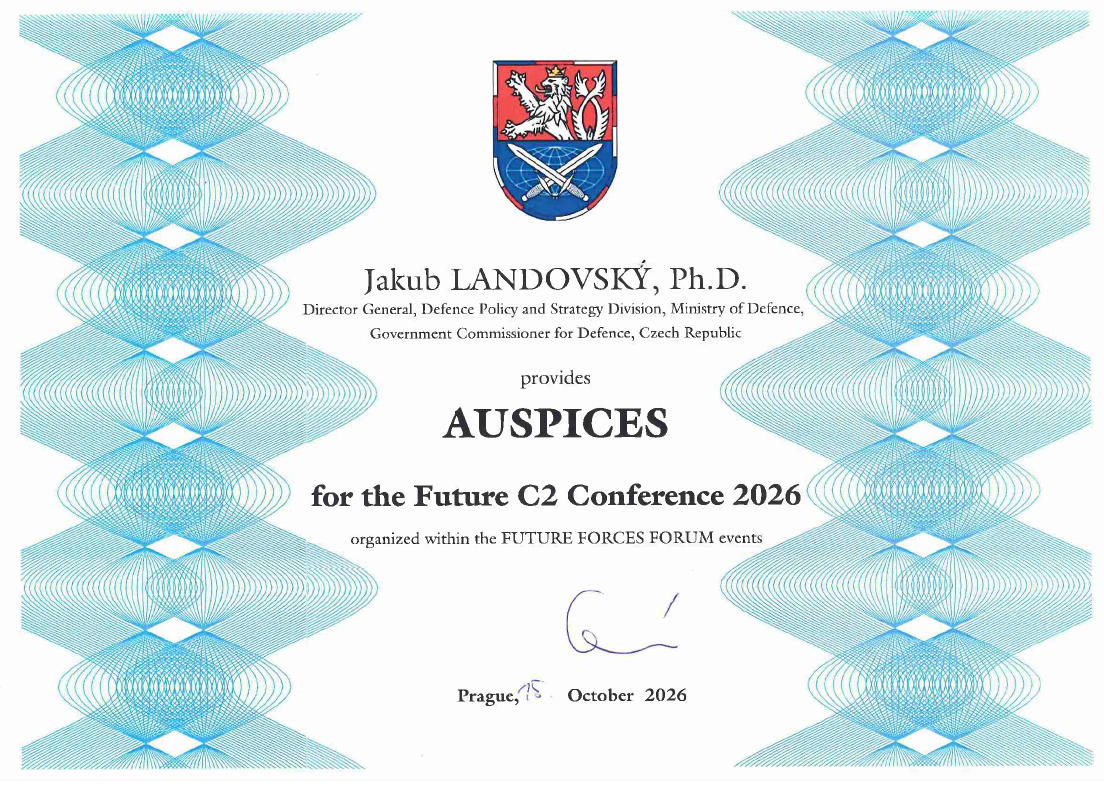
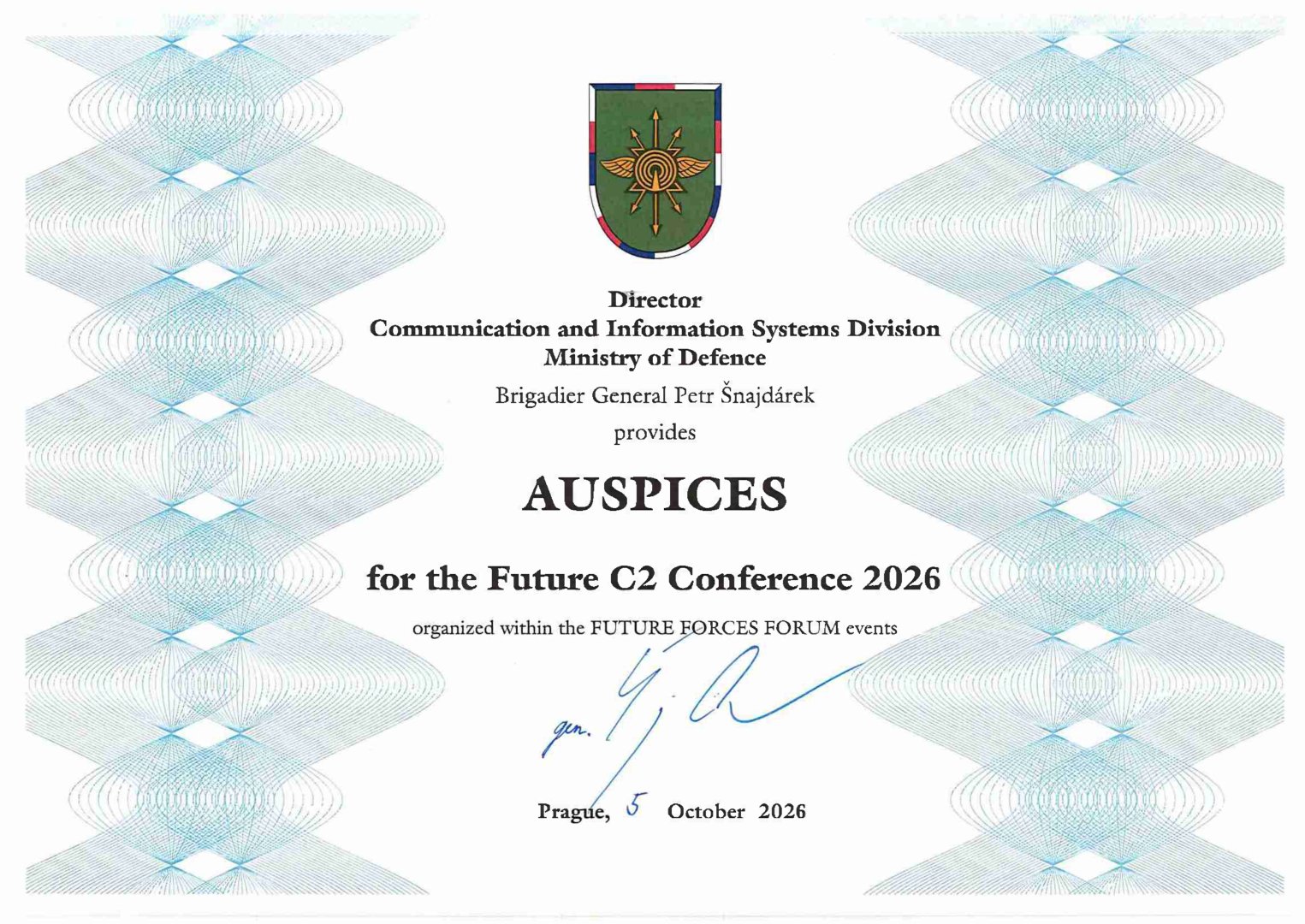
Under the Auspice of
Under the Auspice of Director |
|
Conference Partners |
|
|
|
FFF General Partner |
|
|
|
FF26 General Partner |
|
|
|
FFF Strategic Partner |
 |
| FF26 Main Partner |
 |
| FF26 VIP Lounge Sponsor |
 |
| FF26 Specialized Partner |
 |
|
FFF Partner
FFF R&D Partner
|
|
Mobility Partner |
|
|








- DATE: 22 October 2026
- VENUE: PVA EXPO PRAGUE, Entrance Hall 2, Conference Room 1
- OFFICIAL LANGUAGE: English
- FORMAT: International Conference
- PROGRAMME
- CONFERENCE FREE REGISTRATION
- Conference is part of the Future Forces Exhibition & Forum 2026

Future Command and Control (FC2) Conference 2026 – Mastering the Electromagnetic Environment
Conference Context and Background
Following the successful Future C2 (FC2) conference in 2024, the FC2 brand returns to the Future Forces Forum 2026 with a highly specialized focus. Current global conflicts and technological advances make clear that the Electromagnetic Environment (EME) has become a decisive factor in modern warfare. Where electromagnetic spectrum activities were once regarded primarily as combat support functions, they are now seen as a force multiplier, key capability, with the potential to deliver a decisive impact across all domains and joint warfare functions, including command and control (C2).
The conference responds to the dynamic transformation of the security and operational environment, where the boundaries between military and civilian activities in the electromagnetic spectrum are increasingly blurred. The goal of FC2 2026 is to discuss strategies, technologies, and relevant doctrinal imperatives, which will ensure the technological superiority and effective resilience of our nations and our armed forces, thus strengthening our collective defence and deterrence. All that in the context of the rapid escalation of hybrid activities as well as growing risk of a direct military challenge against us.
Objectives and Strategic Significance
The main purpose of the conference is to highlight the critical importance of gaining superiority in the electromagnetic spectrum at a given time and place.
The conference focuses on:
- Integrating electromagnetic operations (EMO) into the concept of multi-domain operations.
- Building cross-sectoral resilience that links military capabilities with the protection of critical civilian infrastructure.
- Information sharing and coordination among the military, government, and industry — not only in times of war but also in peacetime (including peacetime crises).
- Military spectrum management as the cornerstone for creating a Recognised Electromagnetic Picture.
Main Thematic Blocks (Panels)
I. Strategies, Doctrines, and Trends in the Electromagnetic Spectrum
Focus on doctrinal changes shaped by activities in the EMS, such as electromagnetic and navigation warfare, signals intelligence, and the suppression of air defence. The discussion will examine approaches to maintaining dominance in the era of hybrid threats and the challenges of spectrum sharing between military and civilian actors.
II. Interdisciplinary Resilience: A Challenge for Military and Civilian Practice
Analysis of the tactical and strategic aspects of electromagnetic attack and defence, with an emphasis on critical infrastructure protection. A key topic is coordination between the military and the civilian sector in building stability and defence against deliberate interference in the EMS, including the role of the defence industry in maintaining long-term resilience.
III. ISTAR and Support for Electromagnetic Operations
Integration of reconnaissance, surveillance, and target acquisition to ensure real-time situational awareness. Emphasis is placed on data fusion, automated analysis, and the use of advanced technologies to create a common operational picture, with due regard for the legal and ethical dimensions of sensitive data handling.
IV. Research, Development, and Innovation for Technological Superiority
Linking academia, startups, and industry. Focus on trends such as directed-energy weapons, quantum sensors, and artificial intelligence in electronic warfare. The panel will also discuss challenges in the areas of standardisation, certification, and technology transfer from laboratory to battlefield.
The panel will additionally address the security and legal aspects of spectrum use — including EMS regulation and management, personal data protection, and cyber-spectral threats. It will examine liability for damages caused by EMS operations in the context of international law, and the importance of transparency in military activities for maintaining public trust.
Side Events and Networking
The conference features a rich programme of side events, including:
- A technology exhibition where leading defence industry firms and innovative startups will present their solutions.
- Networking platforms for direct interaction between experts from the armed forces of NATO and partner nations, government officials, academic researchers, and representatives of the security industry.
Concluding Framework (Vision 2035+)
The FC2 2026 conference aims to formulate recommendations for strategic direction that will enable stakeholders to address threats and risks related to the electromagnetic environment and the activities of military forces within it over the coming decade. The outcomes of the discussions should contribute to better preparedness for high-intensity conflicts, where the ability to “see sooner and understand faster” in the electromagnetic spectrum will determine survival and victory.
Programme
| 9.30 – 10.20 | Opening and Keynote Address |
|
Conference opening: LtGen. ret. Jiří BALOUN, Ph.D., former Ambassador of the Czech Republic to Afghanistan (moderator) |
|
|
Opening speech: Mr. Jakub LANDOVSKÝ, Ph.D., Director General of the Defence Policy and Strategy Division, Government Commissioner for Defence, Ministry of Defence, Czech Republic |
|
|
Keynote address: Col. Christian BARTSCH (DEU A), Head, Digital Strategy and Policy Section, Cyber and Digital Transformation Division, NATO HQ |
|
| 10.20 – 11.20 |
PANEL I - Strategies, Doctrines, and Trends in EMS |
|
MODERATOR: LtGen. ret. Jiří BALOUN Mr. Jakub LANDOVSKÝ, Ph.D., Director General of the Defence Policy and Strategy Division, Ministry of Defence, Government Commissioner for Defence, Czech Republic Col. Christian BARTSCH (DEU A), Head, Digital Strategy and Policy Section, CDT Division, NATO HQ BG Petr ŠNAJDÁREK, Director of Communications and Information Systems Division and Commissioner for Digitization, Ministry of Defence, Czech Republic Col. Petr HLAVIZNA, Ph.D., Vice Rector for External Relations and Internationalization, Chair, Department of Intelligence Support, University of Defence, Czech Republic Maj. Radek SVOBODA, Intelligence Support Division, Ministry of Defence, Czech Republic |
|
| 11.20 – 11.40 | Coffee Break |
| 11.40 – 12.30 | PANEL II - Interdisciplinary Resilience and Infrastructure Protection Navigation warfare, signals intelligence, and the coexistence of military and civilian actors |
|
MODERATOR: LtGen. ret. Jiří BALOUN Col. Ass. Prof. Jiří VESELÝ, Ph.D., Head, Department of Communication Technologies, Electronic Warfare and Radiolocation, University of Defence, Czech Republic Mr. Jakub THOMAS, Member of the Board, Commercial Director, ERA Col. Jiří HUBIČKA, Intelligence Support Division, Ministry of Defence, Czech Republic Mr. Marijn MARKUS, |
|
| 12.30 – 13.40 | Lunch & Future Forces Technology Exhibition Tour |
| 13.40 – 14.40 | PANEL III - ISTAR and Support for Electromagnetic Operations Situational awareness (REMP), analysis automation, and interoperability |
|
MODERATOR: LtGen. ret. Jiří BALOUN LtCol. Pavel KRAINA, Intelligence Support Division of the Ministry of Defence, Czech Republic Dr. Vasileos KATSAMPAS, Cyber and Digital Transformation Division, NATO HQ LtCol. (Res.) Michael (Miki) SHENKMAN, Director of Marketing and Business Development, C4ISR Directorate, RAFAEL LtCol. Radovan VAŠÍČEK, Ph.D., Instructor, Department of Intelligence Support, University of Defence, Czech Republic Mr. Pavel KOTYK, Ph.D., Business Development manager,PRAMACOM-HT |
|
| 14.40 – 15.40 | PANEL IV - Innovation, Research, and Security/Legal Aspects Inovation, the role of startups, AI, spectrum management, and ethics |
|
MODERATOR: Mr. Jiří ŠEDIVÝ, Ph.D., former Minister of Defence, Head of the Permanent Delegation of the Czech Republic to NATO, CEO EDA Col. Vlastimil NEUMANN, Ph.D., - Dean of the Faculty of Military Technology, University of Defence, Czech Republic Col. (ret.) Milan NOVOTNÝ, European Defence Agency Col. (ret.) Martin HLAVÁČEK, Head of the Information and Communication Systems Certification Division, National Cyber and Information Security Agency Mr. Marijn MARKUS |
|
| 15.40 – 15.45 | Closing remarks: LtGen. ret. Jiří BALOUN (moderator) |